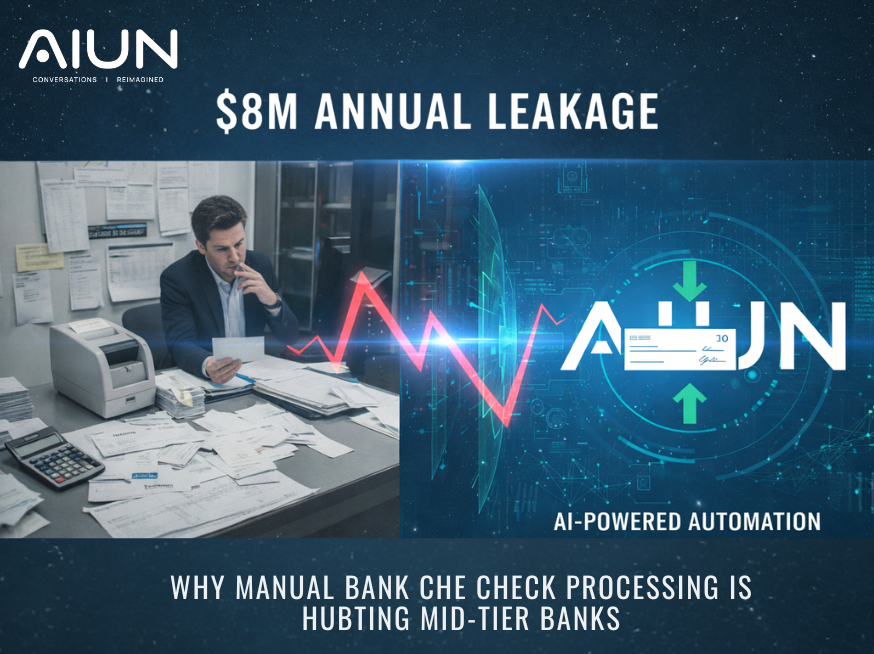
The $8M Annual Leakage: Why Manual Bank Check Processing Is Still Hurting Mid-Tier Banks
Digital Banking Is Growing but Checks Are Not Going Away
Digital payments continue to expand rapidly with real time transfers, mobile banking and instant settlement becoming standard across financial systems. Despite this transformation checks remain deeply embedded across the US, India and several global markets particularly for corporate payments, government disbursements and high value settlements.
Mid tier banks alone process between 250000 and 1 million checks each year. Many still depend on semi manual workflows, basic scanning tools and legacy Check Truncation System CTS environments. While these systems enable image exchange they do not automate the operational lifecycle of check transactions.
This dependency creates a silent operational leakage that can exceed eight million dollars annually. The problem is not the existence of checks. The problem is how they are processed.
Manual validation, disconnected systems and fragmented reconciliation processes continue to create inefficiencies across banking operations. This is precisely where the AIUN Bank Check Automation platform becomes relevant by closing the automation gap through intelligent end to end workflow control.
The Real Cost of Manual Check Processing
Manual check processing appears straightforward but the actual workflow involves several operational stages and system handoffs.
Typical processes include
- Image scanning
- Manual data validation
- Signature verification
- Email based exception routing
- Manual GL posting
- Delayed compliance review
Even within CTS compliant environments many institutions stop at image capture rather than implementing intelligent validation and workflow automation. This results in recurring operational inefficiencies that are difficult to measure but expensive at scale.
Where the $8M Leakage Comes From
Underestimated Cost per Check
Mid tier banks often focus on transaction volume instead of actual processing cost. Even a small inefficiency of six to ten dollars per check compounds significantly when hundreds of thousands of transactions move through the system annually.
These hidden inefficiencies gradually erode operational margins.
Higher Operational Headcount
Manual verification relies heavily on operations teams. As check volumes increase staffing requirements grow proportionally. This increases operational expenses and slows transaction processing.
AIUN reduces manual intervention by enabling structured straight through processing where validated transactions move automatically into enterprise systems.
Reconciliation Delays
Manual posting often creates inconsistencies between operational systems and financial ledgers. Reconciliation becomes a daily operational challenge affecting settlement timelines and financial reporting.
AIUN embeds reconciliation intelligence directly into the workflow so validated transactions move automatically into ERP and core banking systems without manual re entry.
Compliance Exposure
Manual validation processes frequently lack consistent audit visibility. Weak documentation and inconsistent validation logic increase regulatory pressure and reporting complexity.
AIUN provides structured audit trails where every transaction step is logged and traceable ensuring operational transparency.
Legacy Infrastructure Cost
Fragmented legacy platforms require ongoing maintenance and operational oversight. These systems were not designed to support modern transaction volumes or integrated workflows.
AIUN replaces fragmented processes with a unified bank check automation platform improving operational resilience and reducing infrastructure overhead.
Why Traditional Check Scanning Tools Are Not Enough
Many financial institutions believe they have automated check processing simply because they use scanning software or digitization tools.
These systems capture visible information from check images but they do not deliver operational intelligence or automated decision making.
Traditional tools cannot
- Validate MICR information intelligently
- Cross check payee and amount relationships
- Identify duplicate entries across transactions
- Structure extracted data for automated posting
- Route exceptions through intelligent workflows
Digitizing paper alone does not automate banking operations.
AIUN extends beyond simple digitization by combining intelligent data extraction, structured validation and automated workflow orchestration to deliver complete bank check automation.
What Modern Bank Check Automation Looks Like
True bank check automation integrates intelligent extraction, validation logic and enterprise system integration into a unified workflow.
AIUN focuses on three operational layers.
AI Check Data Extraction
AIUN converts unstructured check images into structured validated data through
- Intelligent field detection
- Automated MICR interpretation
- Payee and amount validation
- Structured data extraction from checks
- API ready architecture
This significantly improves extraction accuracy and reduces manual validation effort.
Intelligent Verification and Transaction Monitoring
AIUN continuously monitors transactions using structured validation logic including
- Duplicate detection
- Pattern anomaly monitoring
- Smart exception routing
- Account activity monitoring
Routine transactions move automatically through the system while exceptional cases are routed for manual review.
Core Banking Integration
AIUN integrates directly with
- Core banking systems
- General ledger modules
- Compliance platforms
- Reconciliation systems
Using secure APIs AIUN enables straight through posting without spreadsheet reconciliation or manual data entry.
CTS Compliance Is Not Enough
A Check Truncation System CTS enables image exchange compliance between banks.
However CTS alone does not provide
- Data validation accuracy
- Workflow automation
- Real time operational reporting
- Reconciliation automation
- Scalable transaction processing
AIUN extends CTS environments by introducing intelligent validation structured data extraction and automated workflow orchestration.
Why Mid Tier Banks Need AIUN
Mid tier banks experience significant operational pressure because they manage large check volumes with limited automation resources.
Key challenges include
- High transaction volumes
- Increasing regulatory expectations
- Growing operational complexity
- Limited modernization bandwidth
AIUN is designed specifically to help mid tier and regional banks modernize check processing without replacing their existing core infrastructure.
How AIUN Helps Automate Bank Check Processing
Step 1 Workflow Assessment
AIUN begins by mapping the complete check lifecycle to identify operational bottlenecks across validation posting and reconciliation.
Step 2 Intelligent Extraction Deployment
AIUN deploys modern Bank Check Automation Software including
- Structured data extraction
- Automated validation logic
- API first architecture
Step 3 Core System Integration
AIUN connects directly with existing banking systems enabling
- Direct posting automation
- Automated exception routing
- Real time operational dashboards
Step 4 Reconciliation Automation
Built in reconciliation intelligence eliminates reporting delays and improves financial visibility.
The Business Impact with AIUN
Banks implementing the AIUN Bank Check Automation platform typically experience
- 30 percent lower processing cost
- 60 to 75 percent faster clearing cycles
- Reduced operational overhead
- Improved compliance visibility
- Stronger audit readiness
Automation becomes a structured operational control layer rather than a simple scanning tool.
Final Thoughts
With AIUN bank check automation becomes a strategic investment in operational efficiency, compliance strength and scalable banking infrastructure.
Modern check automation is not about scanning paper.
It is about protecting margins improving operational control and preparing banking systems for future transaction growth.
FAQ’s
Q1. What is bank check automation?
Bank check automation uses AI driven extraction, validation and workflow integration to process cheque transactions automatically and post them into core banking or ERP systems without manual entry.
Q2. Why is manual bank check processing expensive?
Manual cheque processing requires multiple validation steps, exception handling and reconciliation across systems. These manual touchpoints increase operational cost, slow settlement cycles and create processing inefficiencies at scale.
Q3. How does cheque automation reduce operational cost?
Cheque automation reduces manual verification, automates validation and integrates transactions directly with banking or ERP systems. This lowers processing time, reduces operational workload and improves reconciliation accuracy.
Q4. Can cheque automation work with existing banking systems?
Yes. Modern cheque automation platforms integrate with existing core banking systems and ERP platforms through secure APIs, allowing banks to automate cheque workflows without replacing their infrastructure.
Popular Blogs

05 Nov, 2024
